Prelab: Buck Converter
Please Log In for full access to the web site.
Note that this link will take you to an external site (https://shimmer.mit.edu) to authenticate, and then you will be redirected back to this page.
Back in lecture on April 2nd, we saw the theory and a demo for a simple buck converter. As a reminder, the buck converter is a type of power converter that can be designed to efficiently step down voltage (so opposite of the boost converter we saw in lab two weeks ago). In lecture we saw a buck converter that looked something that looked like this:

In the schematic above, the load is the component to which we are providing power. Our goal it to convert the power, as efficiently as possible, from the source (labeled V_{IN}) to that load. For this week we are also going to model our load as a resistor.
In a buck converter the switches (S_1) and (S_2) operate alternately, meaning when one is conducting the other is open. We call the percent of time S_1 is on during the period the "duty cycle", usually denoted with D. We can adjust the duty cycle anywhere from 0 to 1 and thereby control our output voltage.
That means our v_{\rm SW} waveform (the voltage across the inductor + load circuit) will look like the following, where D can be anywhere between 0 and 1:
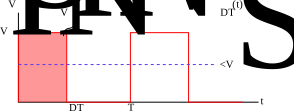
That means we can model our circuit like this:

In this week's lab we are going to treat the buck converter as a square wave with a filter attached, like what is shown above.
Enter your answer as a Python expression, using omega for \omega, j for j, R for R and L for L.
HINT: Using the impedance method lets us treat this like a voltage divider!

If we think about this as a filter, our goal is to filter out all of the ripple voltage on v_{sw} and only pass the DC component to the load. So let's think about how good we are doing that in this circuit.
We haven't talked about how to handle a non-sinusoidal inputs yet. But luckily, every signal (no matter the shape) can be represented as a sum of sinusoids. This is actually very cool and you should take 6.300 to learn more. For simplicity we are going to take what's called the first harmonic approximation of our sqaure waveform (v_{sw}) input to our filter, which is good enough for what we are doing today, but definitely a rough approximation. As a result we can model v_{sw} as the following:
Where A and \phi are dependent on the duty cycle and input voltage and \omega is controlled based on the frequency we are switching our switches. The DC term (DV_{IN}) determines the average output voltage. But the AC term (\tilde{v_{sw}} = A\cos\left(\omega t - {\phi}\right)) is what will be filtered by our LR filter above.
Based on this approximation for our input to our LR filter above, we can now understand how our the AC portion of our output voltage (\tilde{v_{out}}) will look under different operating conditions.
Consider the following parameters, which match our design in lab this week:
- L = 2.2 mH
- R = 120 \Omega
- f_{\rm sw} = 25 kHz
Whoa, this isn't great, that means that roughly one-third of the ripple from our v_{sw} also shows up on our output voltage. Depending on your application this can be a problem becuase of increased loss or the load requirements, for example often we are limited to 5% peak-to-peak ripple for battery applications. So we have two choices:
- Switch faster, if we move further away from our filter's cut off frequency we can attenuate the ripple more. However, the faster the switch the larger our losses will become.
- Build a better filter. One option would be to move our cut off frequency lower by choosing a bigger inductor, but then the converter will be larger.
So what if we instead use a different kind of filter which can increase the attenuation without requring us to increase the switching frequency?
Let's consider the following circuit where a capacitor is added in parallel with the load resistor, as shown below.

Enter your answer as a Python expression, using omega for \omega, j for j, R for R, L for L, and C for C.
HINT: Using the impedance method lets us treat this like a voltage divider!
Consider the following parameters, same as above, with an addiitonal 0.1 \mu F capacitor:
- L = 2.2 mH
- R = 120 \Omega
- C = 0.1 \muF
- f_{\rm sw} = 25 kHz
As you will see in lab, the added capacitor is very small and gives us a large benefit in terms of reduced output voltage ripple. We will also see what happens as we increase the capacitance, and measure the effect on the output voltage ripple.